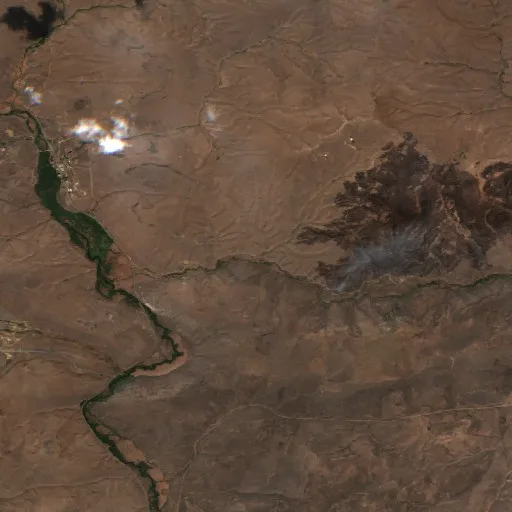
 True view
Fire view
Fire view (right): infrared (SWIR), sees through smoke and brings out the heat.
🟢 green = vegetation
🟤 brown = already burned
🟠 orange = fire right now
Drag to compare: normal photo on the left, heat brought out on the right.
Green: vegetationBrown: already burnedOrange: fire right nowSentinel-2 · Copernicus
Red dots: heat detected by satellite in the last 48h. NASA FIRMS
Key facts
Source: NIFCGlossary: what each term means
Barely moving. Low, thin smoke.
Burning without flame, in the ground or in roots. Can flare up days later.
Moves slowly, hugging the ground.
Spreads with low, steady flames.
Spreading evenly and steadily, with visible flame.
Fast and unpredictable.
Runs along the ground much faster than a person walks.
Grows along the sides, not head-on.
Moves against the wind or downhill, which makes it slower.
Climbs into the treetops and jumps crown to crown. It can't be attacked from the ground.
Climbs into the crowns in bursts and drops back down.
Whole trees flaring up like torches.
Single scattered trees flaring up whole, like torches.
Whole clumps of trees flaring at once.
Wind carries embers through the air and starts new fires ahead of the front: that is how a fire jumps a road or a firebreak.
The wind pushes it in long runs in one direction.
The ones marked ● are the behaviors that make a fire harder to stop. They are not a warning or an instruction: they are the description written by the agency in charge. For decisions, always follow your emergency services.
The story so far
Burning across private land in Elko County, the California Creek Fire near Mountain City, Nevada, has officially ended after a 77-day run that consumed 984 acres at an average daily growth of about 13 acres per day. The incident began on August 25, 2026, and ultimately burned through short grass one foot tall. Throughout its duration, the fire was managed as a Type 4 Incident with 52 personnel assigned to the response, bringing the total cost of operations to about $170,000.
By the time the fire reached 100 percent containment and concluded, its behavior had slowed to minimal, smoldering, and backing activity. The seasonal context reflects a broader landscape in 2026, where 3,511,067 hectares have burned nationwide—marking a total that sits 36 percent below the two-decade average for the country. This particular incident unfolded within the typical bounds of the regional fire season, which traditionally spans from June to October.
In context
This wildfire burned in Nevada for 3 days. In total it burned about 984 acres — around 4.0 km².
In the Northern Hemisphere, wildfire activity usually peaks during the warm, dry months — roughly May through October.
The bigger picture in United States
Across United States, roughly 3,594,094 hectares have burned so far in 2026 — 34% below the two-decade average. Data from Copernicus GWIS.
Alerts near Mountain City
This fire is over. We'll email you if satellites detect new fire in this area. Free, no account.
Get alerts United States todayLive
Community reports
Reports from people near the fire · unverified
Be the first to report what is happening →
Not official emergency information. In an emergency, contact fire services/authorities.
More fires in Nevada
See all Bull FireEnded · 1,529 acres
 Ward FireEnded · 8,683 acres
 Secret Pass FireEnded · 3,300 acres
 Chimney FireEnded · 20,985 acres
 Stallion FireEnded · 40,691 acres
 Kearny FireEnded · 300 acres