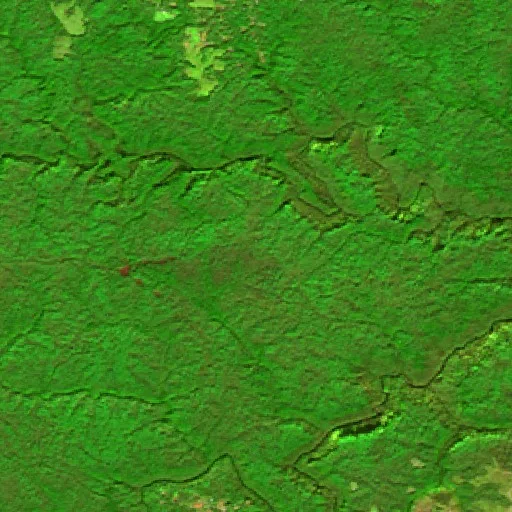
Green: vegetationBrown: already burnedOrange: fire right nowSentinel-2 · Copernicus
Red dots: heat detected by satellite in the last 48h. NASA FIRMS
Key facts
Source: NIFCGlossary: what each term means
Barely moving. Low, thin smoke.
Burning without flame, in the ground or in roots. Can flare up days later.
Moves slowly, hugging the ground.
Spreads with low, steady flames.
Spreading evenly and steadily, with visible flame.
Fast and unpredictable.
Runs along the ground much faster than a person walks.
Grows along the sides, not head-on.
Moves against the wind or downhill, which makes it slower.
Climbs into the treetops and jumps crown to crown. It can't be attacked from the ground.
Climbs into the crowns in bursts and drops back down.
Whole trees flaring up like torches.
Single scattered trees flaring up whole, like torches.
Whole clumps of trees flaring at once.
Wind carries embers through the air and starts new fires ahead of the front: that is how a fire jumps a road or a firebreak.
The wind pushes it in long runs in one direction.
The ones marked ● are the behaviors that make a fire harder to stop. They are not a warning or an instruction: they are the description written by the agency in charge. For decisions, always follow your emergency services.
The story so far
The Bsp - Cactus Fire, located 11 miles east of Jamestown, Tennessee in Fentress County, is currently fully contained after burning for 16 days. The fire, which started on October 29, 2026, consumed 220 acres of hardwood litter under federal management by the National Park Service. During its spread, the fire grew at an approximate rate of 14 acres per day.
Fire behavior is currently reported as minimal. The incident is managed by a Type 4 Incident Commander with a Type 5 Incident complexity, utilizing a modest crew of 9 personnel. Total suppression costs have reached about $30,000.
This incident occurs within a broader regional context where the typical fire season spans from June to October. Nationally, 3,540,413 hectares have burned so far in 2026, marking a figure that is 35% below the two-decade average.
In context
This wildfire has been burning in Tennessee for 16 days. So far it has affected roughly 220 acres — about 0.9 km². The perimeter is 100% contained.
In the Northern Hemisphere, wildfire activity usually peaks during the warm, dry months — roughly May through October.
The bigger picture in United States
Across United States, roughly 3,540,413 hectares have burned so far in 2026 — 35% below the two-decade average. Data from Copernicus GWIS.
Follow this fire
We'll email you if it grows, if it gets more contained, or if it goes out.
At most one alert every 6 hours, and only when something changes. No account, one-click unsubscribe. Privacy
Or get alerts for any new fire near here →Active fires nearby1 · 100 km
 United States todayLive
Community reports
Reports from people near the fire · unverified
Be the first to report what is happening →
Not official emergency information. In an emergency, contact fire services/authorities.
More fires in Tennessee
See all Campbell - Glassman Way FireActive · 380 acres
 Wildfire near Rhar el MelahEnded · about 200 hectares (estimated)
 Wildfire near MateurEnded · about 100 hectares (estimated)
 Wildfire near TouirefEnded · about 330 hectares (estimated)
 Wildfire near Djebel AbiodEnded · about 350 hectares (estimated)
 Wildfire near NibbarEnded · about 180 hectares (estimated)